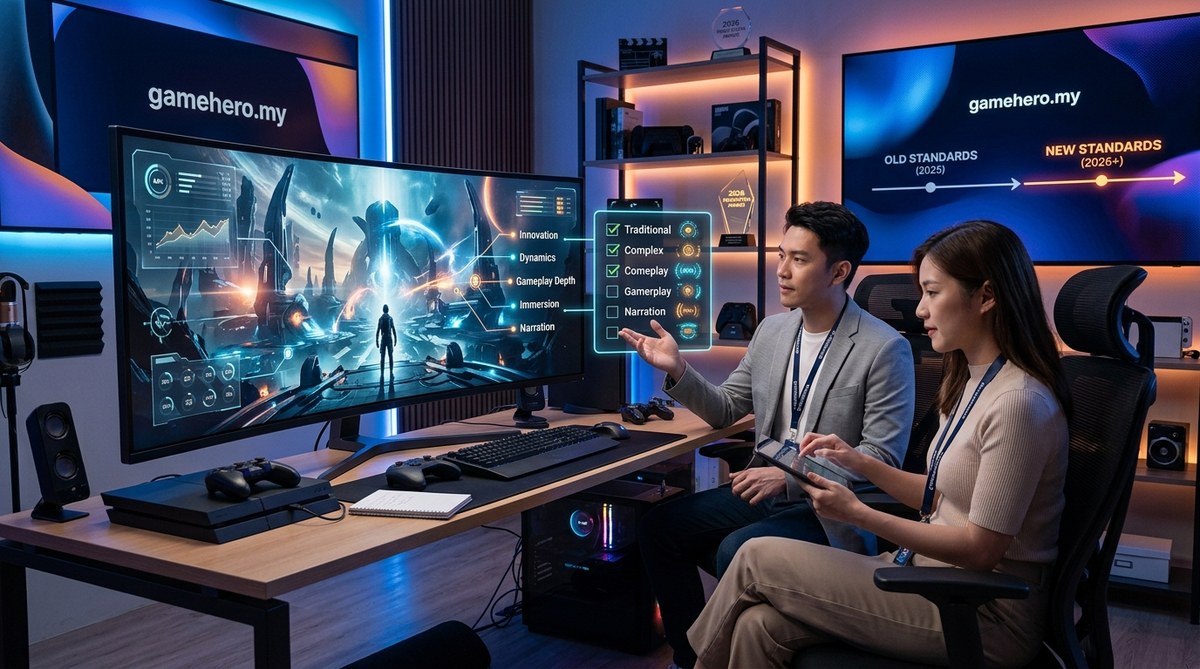
A few years back, if a game shipped with solid mechanics and a decent story, it could score an 8 out of 10. That logic doesn’t hold in 2026. The landscape has shifted. New tech, new player expectations, and a flood of creative experiments have forced us to rethink everything. At Game Hero, we spent months questioning our own process. We talked to developers, watched thousands of hours of gameplay, and read player feedback across forums and social channels. The result? A complete overhaul of our review approach. We are not just changing numbers. We are changing how we see games.
Game Hero’s updated review standards in 2026 focus on innovation, long-term engagement, and accessibility. We moved away from a simple checklist towards a holistic evaluation that rewards risk-taking and player-centric design. This shift helps gamers identify titles that truly push boundaries, while holding developers accountable for meaningful experiences.
What Drove the Change?
The old review standards leaned heavily on technical performance and genre conventions. A well-optimized shooter with solid gunplay could coast by, even if it offered nothing new. Players on our site told us that felt hollow. They wanted to know: does this game matter? Does it try something bold, even if it stumbles?
At the same time, 2026 brought breakthroughs in AI, procedural storytelling, and mixed reality. Games like Echoes of Silicon and Planetfall Reborn challenged traditional formats. Reviewing them with a 2019 scorecard would be like judging a smartphone by its rotary dial. We needed new eyes.
The Three Pillars of Our 2026 Standards
We built our new system around three core questions. Every game gets evaluated against these pillars.
1. Innovation Over Iteration
Does the game expand the medium? It could be a novel control scheme, a narrative structure that adapts to your choices in real time, or a multiplayer system that redefines social play. We reward ambition. A game that tries something new and gets 80% right might score higher than a polished clone that plays it safe.
2. Player Respect
This covers monetization, difficulty, and pacing. Does the game respect your time and wallet? We have zero tolerance for exploitative microtransactions or grind designed to push purchases. Accessibility options are now a scoring factor. If a title ignores colorblind modes or rebinding controls, it loses points.
3. Lasting Impact
How does the game feel after ten hours? After fifty? We introduced a “replay audit” where reviewers play the game for at least 20 hours (more for competitive or live-service titles). We also factor in community tools and mod support.
How We Score Now: A Practical Process
Applying the pillars requires structure. Here is the step-by-step method our reviewers follow for every 2026 game review.
- First Contact (0-2 hours). Play without looking up guides or maps. Note the onboarding flow, tutorial quality, and initial hook.
- Mid-Game Assessment (10 hours). Evaluate the innovation pillar. Are there moments that surprise you? Does the game build on its early ideas or repeat them?
- Player Respect Check. Count the number of store pop-ups, analyze the progression curve, and test all accessibility settings.
- Long-Term Test (20 hours+). Revisit after a week. Does the desire to return fade or grow? For online multiplayer, we also play with randoms to gauge community health.
- Final Scoring Session. The reviewer writes a detailed report. A second reviewer then plays for 5 hours blind to verify major claims. Scores are finalized only after both agree.
This process replaced the old single-reviewer system. It costs more time but catches blind spots.
Common Pitfalls (and How We Avoid Them)
We learned from past mistakes. Here is a table showing what we used to do wrong and what we do now.
| Old Approach | Problem | New Approach |
|---|---|---|
| Review after 5-8 hours | Missed late-game padding or broken economies | 20-hour minimum plays |
| Score based on genre expectations | Penalized experimental hybrids | Judge on intent and execution |
| Ignored monetization unless egregious | Accepted “fair” pay-to-win structures | Zero tolerance for predatory loops |
| Single reviewer | Personal bias could skew score | Two reviewers per game |
| No replay audit | Some games had great first acts, terrible thirds | Separate longevity score |
We still love a good linear shooter. But we no longer hide behind “it’s a solid entry in the series.” That phrase is gone from our vocabulary.
What Players Say About the New Standards
“I bought a highly rated 2026 RPG based on the old system. It was beautiful but had a store that pushed $50 skins. Your new review made me reconsider. Thank you for holding them accountable.” – Player feedback from our Discord
This feedback pushed us further. We also added a “buyer alert” badge for any game that scores below 6 in player respect. It appears right next to the score on the review page.
The Tech Behind the Change
Our team built a custom tool that tracks playtime per session and flags potential grinding loops. We also integrate community sentiment data from Reddit and other forums. This helps us spot trends like “the game gets worse after Act 2” before we publish. It is not perfect, but it adds a layer of objectivity.
For a deeper look at how analyze new releases, read the ultimate guide to analyzing new game releases for serious gamers.
A New Category: The “Bold But Broken” Designation
Some games in 2026 are brilliant yet flawed. They crash often, have UI issues, or lack polish. Under the old system, they’d get a 4 or 5 and vanish. Now we have a special “Bold But Broken” tag. These games receive a review that highlights their innovative ideas, but also warns about stability. We believe players deserve to know about hidden gems even if they need patches.
An example: Neural Shift launched with a revolutionary mind control mechanic but suffered from frequent crashes on PC. We gave it a 7 for innovation but flagged the technical problems. Within two months, the developer fixed most issues, and the game climbed in our recommendations.
What This Means for Developers
We hope our new standards encourage risk. If a studio tries something daring, we will meet them halfway. We will not punish rough edges as harshly if the core is fresh. At the same time, we have no patience for predatory design. Our stance is clear: respect players first, then profit.
Developers often ask for review guidelines. We published a public document on our site. It includes our scoring rubric, the player respect checklist, and examples of what we consider innovation. Transparency helps everyone.
Should You Trust a 2026 Score More?
Yes. Our scores now reflect longer, more thoughtful play. But no score tells the whole story. We encourage readers to read the full review, especially the “who is this for?” section we added. That section tells you if the game suits completionists, casual players, or multiplayer fans.
For example, Wanderlight scored an 8 overall, but our review noted it is best for short session players. If you love long marathons, you might prefer top mobile games of 2026 you can’t miss for quicker fun.
How the Industry Reacted
Reaction has been mixed. Some publishers dislike the player respect pillar because it penalizes their revenue models. Others, especially indie studios, applaud the shift. Several have reached out to ask for earlier access so they can fix issues before our long play tests. We offer that for free, without any promise of a high score.
A Glimpse at the Future
We plan to add an “AI interaction” score next year. Games that use generative AI for dialogue or quests need transparency. Is the AI trained on licensed data? Can the player turn it off? We think players deserve clarity.
Also, we are experimenting with video reviews that show our playtime timestamps, so you can see exactly when we encountered a good or bad moment. Trust requires evidence.
Tips for Players Using Our New Reviews
- Check the “Bold But Broken” tag. You might discover a gem worth the patience.
- Read the player respect section. It tells you how the game treats your wallet and time.
- Look at the two reviewer scores. They are always within 1 point of each other. If they differ more, we hold the review until we agree.
We also maintain a list of titles that improved post-launch. Check out 2026’s most anticipated game releases reviewed to see which games delivered on their promises.
The Bigger Picture: Why We Keep Iterating
Review standards are never finished. The medium evolves, and so must we. Our team revisits these criteria every six months. We survey readers, analyze trends, and adjust weights. In 2025, we realized we undervalued replayability. For 2026, we gave it a full pillar.
This is not about making reviews harder or easier. It is about making them honest. A 9 in 2026 means something different than a 9 in 2022. That is fine. Players are smarter now, and they deserve context.
Final Thoughts on 2026 Game Review Standards
We changed our standards because games changed. Innovation deserves a spotlight, not a penalty. Player respect should be a baseline, not a bonus. And lasting impact matters more than a pristine launch window.
If you are a gamer wondering which titles live up to the hype, trust our process. We put in the hours so you do not have to waste yours. If you are a developer, challenge yourself. Build something that makes us argue for hours about its score.
At Game Hero, we are here to help you find the games that matter. We hope our new standards make that search clearer and more rewarding. Happy gaming in 2026.
About the Author