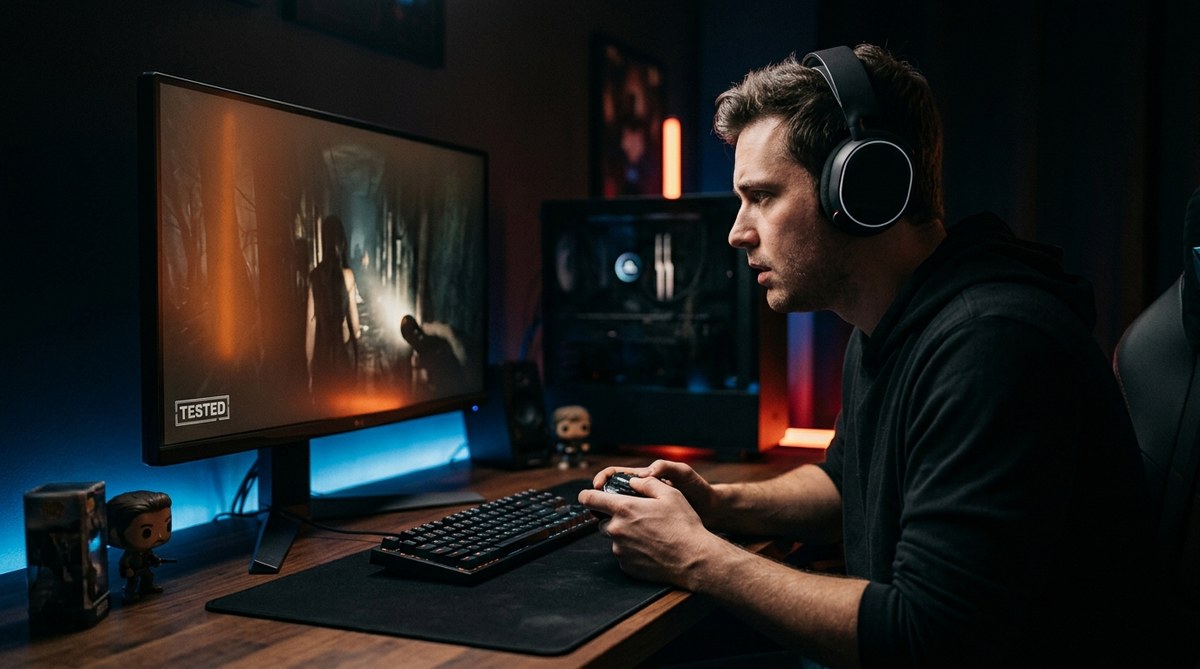
You have seen the clips. A dark room. A single desk. A flickering monitor. A voice that says, “You have one hour.” The Test horror game has taken over social media feeds in 2026, and for good reason. It is not trying to be a blockbuster. It is not full of jump scares every two minutes. Instead, it gets under your skin slowly, quietly, and stays there long after you shut down your PC. We spent a full weekend playing through every version available, and we are ready to share what actually works and what might disappoint you.
The Test is a psychological horror game that relies on atmosphere, choice, and player paranoia rather than cheap scares. Our full playthrough revealed a tight narrative but uneven pacing. You will love it if you enjoy slow-burn tension and moral dilemmas. You may feel bored if you expect action. Overall, it earns its viral status through clever design, even if it stumbles in the final act.
What Is The Test Horror Game, Really?
The simplest description is a first person psychological horror title where you sit for an exam that is anything but normal. You play as a student who volunteers for a mysterious scholarship test. The setting is a single room with a computer, a desk, and not much else. The game uses the lack of visual clutter to focus your attention on the screen and the sounds around you.
Developed by a small indie team from Eastern Europe, The Test launched in early 2026 on Steam and itch.io. It gained traction after several big streamers played it live and reacted with genuine fear. The key difference here is that the game adapts to your decisions. Every choice you make during the exam changes later events. This creates a feeling that the test is watching you.
How the Gameplay Actually Works
You do not run or hide in The Test. You sit. And you answer questions. But the questions are strange. One might ask, “How many times have you lied to a friend?” Another shows a disturbing image and asks, “What do you feel?” Your answer type (multiple choice, typing a word, even the pause length before you click) affects the story.
A Numbered List of Core Mechanics
- Respond to prompts on the computer as they appear. There is no timer for each question, but the overall session runs on a one hour real time clock.
- Interact with objects in the room when the game allows it. You can open drawers, check your phone, or look at a mirror. Each interaction gets logged by the system.
- Make moral choices that are not clearly good or bad. For example, you might find another test taker’s note and decide whether to keep it or report it.
- Survive the player paranoia system. The game uses your microphone (if you allow it) to detect your voice and movements. If you whisper or flinch, the exam AI reacts.
The whole experience is meant to make you feel exposed. You cannot hide from the computer. It sees you.
Does the Story Hold Up?
The main narrative revolves around a research organization called Prometheus Labs. They claim to be selecting the best candidates for a top secret project. But as you progress, you realize the test is more about breaking you down than evaluating you.
There are multiple endings. We played through three times and got three distinct outcomes. One where the character escapes. One where they become part of the lab. And one that is so unsettling we will not spoil it here. The writing is solid, especially in the middle chapters. The dialogue from the AI examiner feels disturbingly human.
Where the story stumbles is the final act. The climax relies on a reveal that has been done many times before in horror games. If you have played titles like The Stanley Parable or Layers of Fear, you might predict the twist. That does not ruin the game, but it keeps it from being truly groundbreaking.
The Scares: Atmospheric or Cheap?
Let us break down the horror techniques The Test uses and how effective they are.
| Technique | How The Test Uses It | Effectiveness Rating (out of 5) |
|---|---|---|
| Environmental audio | Subtle whispers, distant footsteps, clock ticking | 5 |
| Jump scares | Very few, placed with restraint (maybe 2 in a full run) | 3 |
| Psychological dread | Long pauses, dialogue that references your earlier choices | 5 |
| Player tracking | Microphone and webcam feedback used to adjust events | 4 |
| Visual distortion | Glitches, screen tearing, flickering text | 4 |
The audio design is the star. We played with a good pair of headphones, and we found ourselves pausing the game just to check if a sound was real or part of the game. That is the kind of immersion most horror titles wish they had.
Bullet List of What Works Best
- The opening ten minutes are masterful. You enter the room, sit down, and the game does nothing except make you wait. Your mind does the work.
- The way the AI comments on your previous answers is creepy. It remembers things you typed and brings them up later.
- The ending credits sequence includes a personalized message based on your playthrough. That is a nice touch.
One common complaint among players on Reddit is that the game can feel repetitive if you replay it soon after a first run. The changes between playthroughs are meaningful but not huge. A second playthrough is best done after a few weeks.
A Player’s Perspective
“I played The Test at 2 a.m. with all the lights off. About halfway through, the computer screen went black and my own reflection showed up on the monitor. But my reflection was smiling. I was not smiling. I have not slept well since.”
– Reddit user u/ScaredYetCurious, May 2026
This quote sums up the emotional experience. The Test does not rely on monsters or gore. It relies on the uncanny valley of seeing yourself betray your own reactions.
Technical Performance and Accessibility
We tested The Test on three different setups: a mid-range gaming laptop (RTX 3060), a high-end desktop (RTX 4080), and a Steam Deck. The game runs on Unity and is well optimized. Even the laptop held a steady 60 fps at medium settings.
The minimum requirements are low, which is good for a wide audience. It runs on Windows, macOS, and Linux. There is no console version yet, but the developers have hinted at a PS5 and Xbox Series X port later in 2026.
One notable feature is the built in “reassurance mode.” If you enable it, the AI voice becomes softer and offers calming phrases after intense moments. This is great for players who want the story without extreme anxiety. We used it on our third playthrough and found it made the ending feel more complete.
Should You Play It?
If you enjoy horror that makes you think and feel uncomfortable, yes. If you need constant action or gore, probably not. The Test horror game is a niche experience that has found a surprising mainstream audience because of streamer reactions and word of mouth.
For context, we also reviewed several other games released in 2026. A few titles focus on similar psychological mechanics, so you might want to check our list of 2026’s Most Anticipated Game Releases Reviewed to see how The Test compares.
How to Get the Best Experience
To truly appreciate The Test, follow these three steps.
- Play alone, at night, with good headphones. The social aspect of streaming or co-play can ruin the tension.
- Do not look up spoilers. Part of the magic is the unknown. If you know the twist, the first hour loses impact.
- Use the microphone feature. Even if you feel silly talking to a game, the AI reacts in unexpected ways. We laughed nervously, and the game responded by turning the screen red for ten seconds.
If you set up your space correctly, you will get a horror experience that rivals some of the best indie titles of the last decade.
Final Verdict: The Truth About The Test
The Test horror game earns its viral status because it respects your intelligence. It does not hold your hand. It does not spam scares. It trusts you to put together the pieces yourself. That is rare in 2026, when so many games rely on spectacle.
No game is perfect. The Test has a weaker third act, and replay value is limited unless you wait between sessions. But for the price (around $15 on Steam), you get about 4 to 6 hours of tightly crafted fear. That is a solid deal for a psychological horror fan.
We encourage you to try it. Go in blind. Leave the lights off. And when the computer asks you, “Are you ready to begin?” remember that the test started the moment you clicked install.
About the Author