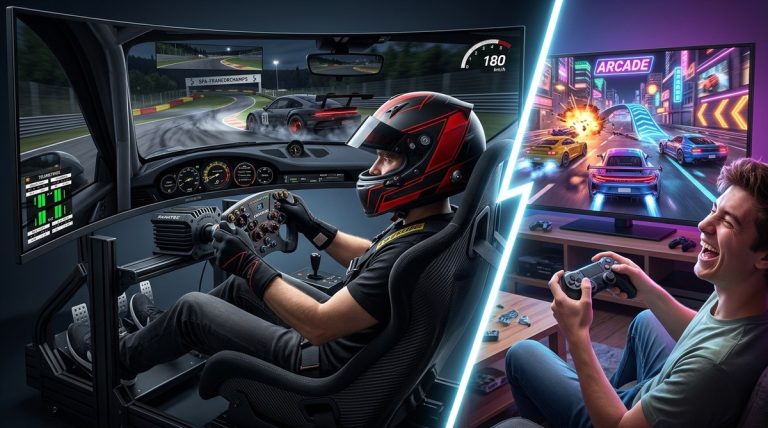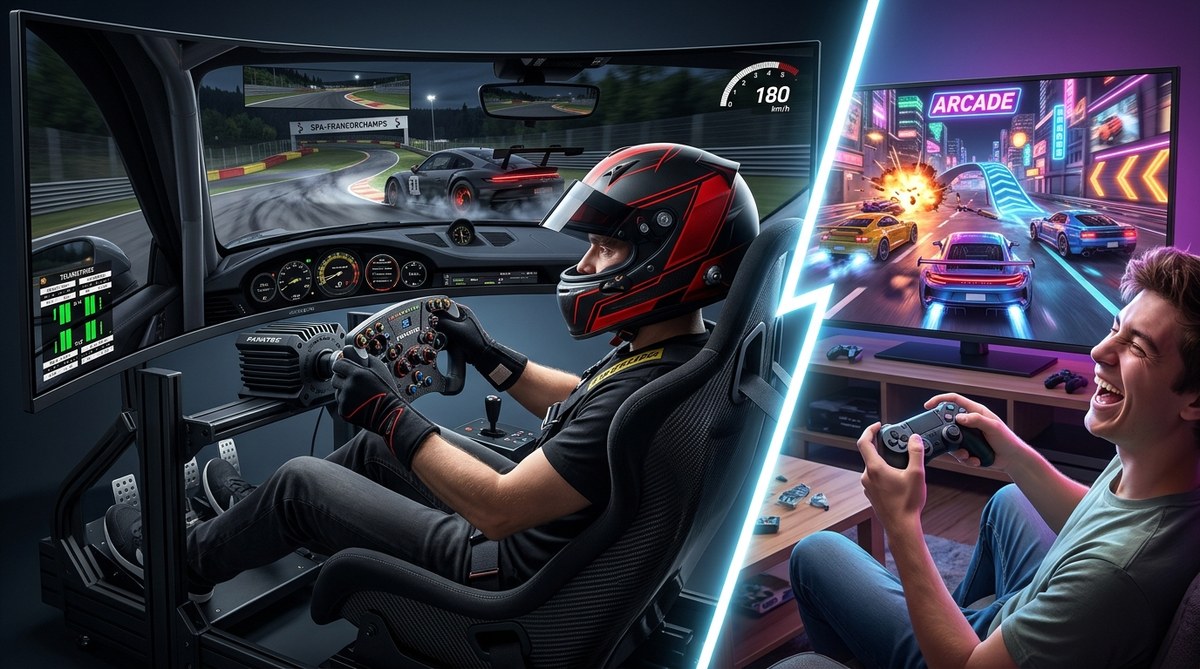
You bought a racing wheel. You set up your gamepad. You loaded up the latest arcade racer. And then you felt it: that nagging sense of disappointment. You cranked the wheel, hit a wall at 180 mph, and bounced off like a rubber ball. No loss of speed. No consequence. Just a shiny score multiplier.
That moment sums up the entire debate around sim racing vs arcade racing. One rewards you for learning real-world car control. The other rewards you for pressing buttons at the right time. If you own a wheel or a gamepad and you are tired of feeling like your skills don’t transfer to anything real, you are in the right place.
Sim racing trains your brain to read tire grip, manage weight transfer, and react to corners with precision. Arcade racers teach you to memorize boost pads and drift triggers. The difference is like learning to cook from a real chef versus following a microwave instruction. This guide will show you exactly how sim racing builds skills that make you a safer, smarter driver on real roads.
What separates sim racing from arcade racing?
The simplest way to understand the split is to look at what each genre values. Arcade racing games prioritize fun and speed over realism. Think of titles where you can drive on walls, collect glowing orbs, or get a speed boost for landing a jump perfectly. Physics takes a back seat to spectacle.
Sim racing games, on the other hand, try to model how a car actually behaves. Weight shifts when you brake. Tires lose grip when you floor the throttle too early. A wet track changes your braking point by several car lengths. These games do not hand you a win for hitting a certain line. They force you to earn it.
If you want to see how this plays out in your own setup, check out our guide on how to optimize your gaming setup for peak performance. The gear you use matters a lot when physics is on the line.
Three ways sim racing rewires your driving instincts
Here are the three biggest changes you will notice after spending time with a proper sim racing game instead of an arcade racer.
-
You learn to read the road before the corner. In an arcade game, you can blast into a turn and tap the brake button for a split second. In a sim, you have to look at the corner entry, judge the camber, and decide your braking point. You start scanning the track like a real driver does.
-
You develop muscle memory for pedal control. Your wheel and pedals matter here. A sim punishes you for stomping the brake or jamming the throttle. You learn to feather the inputs. That skill transfers directly to real driving, especially in slippery conditions.
-
You understand the cost of mistakes. Arcade games let you crash and respawn with no penalty. Sim games often have damage models, tire wear, and even race-ending wrecks. You learn to drive with your head, not just your reflexes.
The arcade trap: why it holds you back
Arcade racing is not evil. It is fun. It is great for a Friday night with friends. But if you own a racing wheel and you want to improve as a driver, arcade physics can actually build bad habits.
Consider this table of common driving situations. Notice how each genre handles them differently.
| Driving situation | Arcade racer behavior | Sim racer behavior | Real-world lesson |
|---|---|---|---|
| Entering a corner too fast | Tap brake, keep full speed | Spin out or run wide | Speed management is critical |
| Wet road surface | No change in grip | Reduced traction, longer braking | Adjust driving for weather |
| Oversteer on exit | Automatic correction | You must countersteer | Understanding weight transfer |
| Collision with barrier | Bounce off, keep going | Damage, loss of control | Consequences teach caution |
Every time an arcade game saves you from a crash, it robs you of a learning moment. Sim racing gives you that moment. It stings. But you remember it.
For more on how to build a setup that supports this kind of learning, take a look at our best gaming accessories to elevate your play in 2026. A good wheel and pedal set makes the feedback loop much clearer.
What the experts say about transferable skills
“The number one thing new sim racers notice after a few months is how much smoother they drive on real roads. They stop jerking the wheel. They look further ahead. They anticipate traffic flow. That is not a coincidence. It is training.” — Professional sim racing coach, 2026
That quote cuts to the heart of the sim racing vs arcade racing debate. Sim racing is not just about winning a virtual championship. It is about building a mental model of how a car moves through space. That model works whether you are behind a keyboard or a real steering wheel.
Common mistakes when switching from arcade to sim
If you are making the jump from arcade racers to sim racing, you will hit some walls. Here are the most common ones, plus how to get past them.
- Braking too late. Arcade games let you brake at the last second. In a sim, you need to brake early and hard, then release smoothly.
- Full throttle too soon. You will spin out on corner exits. Learn to roll onto the gas gradually.
- Ignoring car setup. Arcade games hide things like tire pressure and suspension. Sim games reward you for tweaking them.
- Forgetting to look ahead. Your eyes should be scanning the next corner, not staring at the car in front of you.
If you want to master the deeper side of game mechanics, our ultimate beginners guide to mastering complex game mechanics is a great place to start.
Why 2026 is the perfect year to switch
The sim racing landscape in 2026 is better than ever. Hardware is cheaper. Software is more accessible. Titles like Assetto Corsa Competizione, iRacing, and the newer Le Mans Ultimate offer incredible physics models that run well on mid-range PCs and consoles. Even Gran Turismo 7 on PlayStation has blurred the line between sim and arcade, offering a realistic driving experience that still feels polished.
Meanwhile, arcade racers are leaning harder into fantasy. That is fine for fun. But if you want to grow as a driver, the sim side is where the real gains live.
A practical process to start your sim racing journey
Ready to make the switch? Follow these steps.
- Pick one sim racing title and stick with it for at least 20 hours. Jumping between games slows your learning.
- Turn off all driving assists except maybe automatic clutch. You want to feel the car raw.
- Run the same track over and over. Learn its bumps, camber changes, and braking markers.
- Watch a replay of your lap. Compare it to a real driver’s line on the same track.
- Join a beginner league. Racing against real people teaches you consistency and racecraft.
If you are looking for a good starting point, consider best budget gaming pcs for high performance play in 2026 to make sure your rig can handle the physics calculations without stuttering.
The real test: can you feel the difference?
Here is a simple test you can do right now. Load up your favorite arcade racer. Drive a lap. Then load up a sim racer. Drive the same kind of track. Pay attention to how your hands and feet move. In the arcade game, your inputs are probably binary: on or off. In the sim, you will find yourself making micro-adjustments. Tiny pressure changes on the brake. Small steering corrections. That is the difference between playing a game and learning a skill.
How sim racing improves your real-world driving
Let us get specific. Here are real skills that transfer from sim racing to your daily commute or weekend track day.
- Better hazard perception. You learn to scan the road far ahead, not just the car in front.
- Smoother inputs. Your throttle and brake control becomes gradual, not jerky.
- Understanding of traction. You feel when a tire is about to break loose. You learn to back off.
- Improved spatial awareness. You know where your car is in relation to the lane edges and other vehicles.
- Calm under pressure. Sim racing puts you in high-stress racing situations. You learn to keep your cool.
These are not just gaming skills. They are life skills that make you a safer driver.
The best sim racing games to start with in 2026
Not sure where to begin? Here is a quick list of titles that offer strong physics models and good onboarding for newcomers.
| Game | Best for | Platform | Learning curve |
|---|---|---|---|
| Assetto Corsa Competizione | GT racing focus | PC, PS5, Xbox | Medium |
| iRacing | Online competition | PC | Steep |
| Gran Turismo 7 | Balanced sim-cade | PS5 | Low to medium |
| Le Mans Ultimate | Endurance racing | PC | Medium |
| Automobilista 2 | Variety of cars | PC | Medium |
Each of these titles will teach you something different. If you want to understand the racing side deeper, our top esports strategies to dominate your next tournament has tips that apply to sim racing leagues too.
Why this matters more than you think
The debate around sim racing vs arcade racing is not about which game is more fun. It is about what you want to get out of your time behind the wheel. If you just want to unwind and watch explosions, arcade games are perfect. But if you own a racing wheel or a gamepad and you feel that itch to actually improve, to feel the road through your fingers, to walk away from a session knowing you learned something real, then sim racing is where you belong.
The skills you build in a good sim racing title stay with you. They change how you drive to the grocery store. They change how you react when a car cuts you off. They give you a deeper respect for what a car can do and what it cannot.
Start your sim racing journey tonight
Grab your wheel. Pick one of the sim titles above. Turn off the assists. Run one track until you can nail it consistently. Then try a different car on the same track. Notice how the braking points shift. Notice how the weight of the car changes your corner entry. That is the moment when the sim racing vs arcade racing debate stops being theoretical. That is the moment you become a better driver.
About the Author