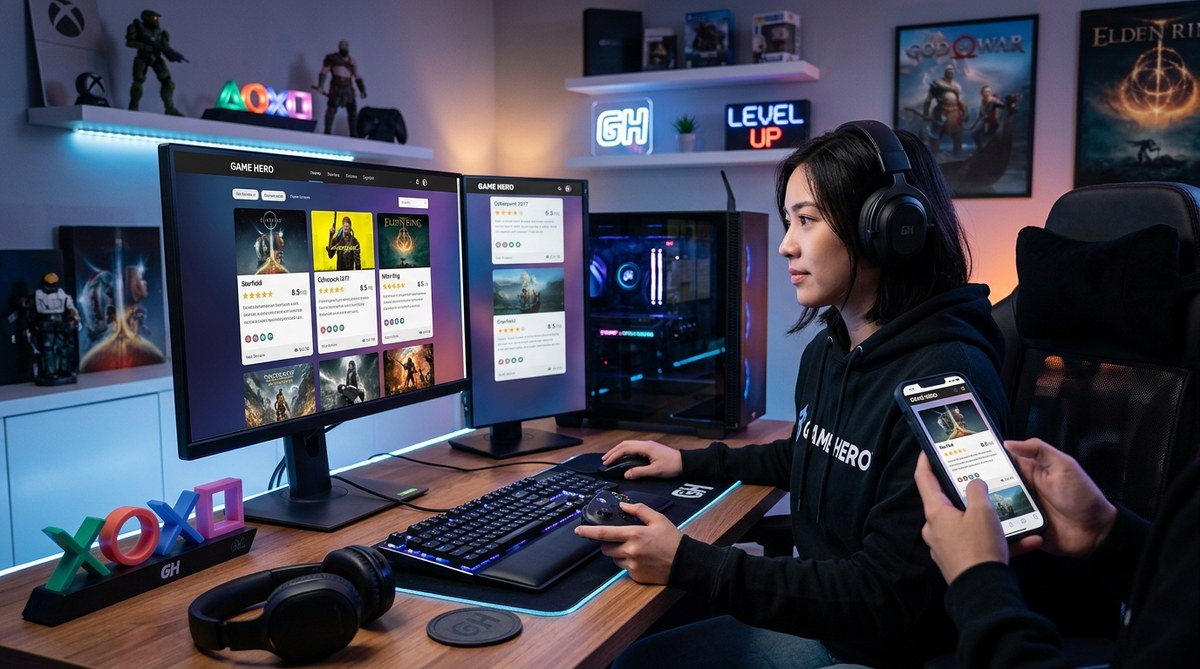
You scroll through the Steam store for forty minutes. Nothing grabs you. Then you see a trailer with explosive graphics, read a glowing quote from a publisher, and buy on impulse. Three hours later, you are bored, frustrated, and thirty dollars lighter. We have all been there. The problem is not a lack of good games. The problem is that most of us treat buying games like a lottery instead of a decision. When you learn how to decide which game to buy next using a structured review method, you stop gambling and start collecting experiences that actually matter to you.
Choosing your next video game does not have to feel like a gamble. By focusing on verified reviews, understanding your own playstyle, and filtering out marketing hype, you can make confident purchases every single time. This guide walks you through a practical system combining trusted review analysis with personal preference mapping. Stop second-guessing and start enjoying games that truly fit you. No wasted money, no regret, just great gameplay from titles you will actually love.
Why Most Buying Methods Let You Down
Your friend swears a game is the best thing they have played all year. You buy it. And you hate it. That is not your friend’s fault. It is a mismatch between their taste and yours. The same happens with YouTube trailers, Reddit hype threads, and even Metacritic scores. Each method has a blind spot.
| Decision Method | What It Does Well | Where It Falls Short |
|---|---|---|
| Friend recommendations | Based on real playtime and trust | Their taste may not match yours |
| Trailer and gameplay videos | Shows visuals and tone | Often hides bugs, pacing, and late-game flaws |
| Aggregated review scores | Gives a broad quality signal | Misses personal fit and genre preferences |
| Our review analysis | Combines quality rating with playstyle fit | Requires a few minutes of reading |
The table above shows the gap. Most sources tell you if a game is good. Few tell you if a game is good for you. That is the core difference. When you rely only on a number or a friend’s opinion, you leave out the variable that matters most: your own preferences.
A better system treats your taste as the starting point, not an afterthought.
The Five Step Review Method for Smarter Purchases
This process works whether you are buying on PC, PlayStation, Xbox, or Nintendo Switch. It takes about fifteen minutes per game and saves you from regret.
Step 1: Define Your Mood and Time Budget
Before you open any review, ask yourself two questions. What kind of experience do I want right now? And how much time do I actually have this week?
Games are not all the same. A 100 hour open world RPG is a terrible choice if you have three hours a week for gaming. A short, intense horror game is a bad pick if you want to unwind before bed. Be honest with yourself. If your answer is “I want something I can finish in a weekend,” then look for linear story games or indie titles that respect your time.
For example, if you are interested in role playing games but need something with a strong narrative that respects a busy schedule, check out our list of Those titles are selected partly because they offer dense, rewarding experiences without unnecessary filler.
Step 2: Read Reviews That Match Your Playstyle
Not all reviews are built the same. A professional critic might love a game for its technical ambition while a regular player struggles with its difficulty curve. When you read a review, look for comments that mirror your own habits.
Ask yourself as you read:
- Does the reviewer mention difficulty settings or accessibility features?
- Do they talk about pacing and length in a way that matches your schedule?
- Are they describing the game’s “feel” or just its features?
GameHero reviews are written with this personal lens in mind. Each review includes a section on who the game is for and who should skip it. That is the part that helps you decide. If you want a deeper look at how to identify a standout title early, read our breakdown on
Step 3: Watch Unedited Gameplay, Not Just Trailers
Trailers are marketing. They show the best three minutes of a thirty hour game. What you need is the real experience. Watch a thirty minute unedited playthrough from a channel that does not overproduce their content. Look for the quiet moments. Look for the menus, the loading screens, the repetitive tasks.
If those thirty minutes feel dull, the full game will feel worse. If they grab you, the game probably has solid core gameplay.
Step 4: Check the Developer’s Track Record
A studio’s history is a strong signal. If a developer consistently releases polished, player friendly titles, their new game is likely in the same family. If a studio has a pattern of broken launches or abandoned projects, wait for post-launch reviews from real players.
This is especially important for 2026 releases. The industry has seen a shift where some studios rush titles to meet deadlines. You do not have to be an early adopter. Patience rewards you with patches, better performance, and honest player feedback.
Step 5: Filter Through the Hype
Every year, a handful of games dominate the conversation. Some deserve the attention. Many do not. Before you buy a game that everyone is talking about, ask one question: does this game actually fit what I enjoy, or am I feeling social pressure?
Hype is a poor guide. It tells you what is popular, not what is right for you. Some of the best gaming experiences in 2026 have come from smaller titles that flew under the radar. In fact, our team has covered how https://gamehero.my/how-indie-games-are-stealing-the-spotlight-from-aaa-titles-in-2026/ because these games often offer more originality and tighter design than their blockbuster counterparts.
Red Flags That Should Stop You From Buying
Even with a good review system, some warning signs are universal. Watch for these in any review or gameplay video.
- Vague praise without specifics. If a review says “this game feels amazing” but never describes what that means, be suspicious.
- Embargoed reviews that drop only on launch day. That often means the publisher knows the game has problems.
- Gameplay that looks scripted or heavily edited in trailers. Real gameplay does not have perfect camera angles and zero UI elements.
- A studio that has not released a patch for known bugs in previous titles. That pattern tends to repeat.
- Reviews that only discuss the first few hours. Some games start strong and collapse later.
“A review that does not mention the game’s weaknesses is not a review. It is an advertisement. Trust the writers who tell you what they did not like. Those are the honest ones.”
From the GameHero editorial team
Building Your Personal Shortlist
Once you have run a few games through the five step method, you will have a shortlist. Keep it visible. Add notes about why each game caught your interest. Over time, you will notice patterns in your choices. You might gravitate toward games with strong character customization or titles that respect your time with save anywhere features.
That self awareness is the real prize. When you understand your own preferences, you can spot a good match in minutes instead of hours.
If you want to stay ahead of the curve, keep an eye on Knowing what is coming lets you plan your purchases instead of reacting to release day hype.
When the Data and Your Gut Disagree
Sometimes a game checks every box on paper but something feels off. Maybe the art style does not click. Maybe the setting does not interest you. Trust that feeling.
Reviews give you information. Your instincts give you context. If a highly rated game does not appeal to you despite strong reviews, skip it. There is no rule that says you must play every acclaimed title. The goal is to find games you love, not to complete a list of critical darlings.
On the flip side, if a game has mixed reviews but something about the premise calls to you, give it a closer look. Read the negative reviews carefully. If the complaints are about things that do not bother you (like a slow start or a complex control scheme), the game might still be a great fit.
For example, some players avoid simulation games because of their complexity. Others find that complexity rewarding. Our piece on https://gamehero.my/what-makes-a-game-a-must-play-in-2026-our-reviewers-weigh-in/ breaks down how different perspectives on the same game can lead to totally different conclusions.
Your Next Move Starts With One Game
The best part of this system is that it gets faster with practice. The first time you use the five steps, it might feel like extra work. By the fifth time, you will instinctively know which reviews to trust and which trailers to skip.
You do not need to overthink this. Pick one game on your shortlist. Run it through the method. If it passes, buy it. Play it. Enjoy it. If it does not, move to the next title on your list.
Every game you skip is a win. Every game you buy with confidence is a win. Over time, you build a library that reflects who you are as a player, not a library full of impulse buys and regret.
So close the store tabs. Stop scrolling. Use the method that works. Your next great game is waiting, and now you know how to find it.
About the Author